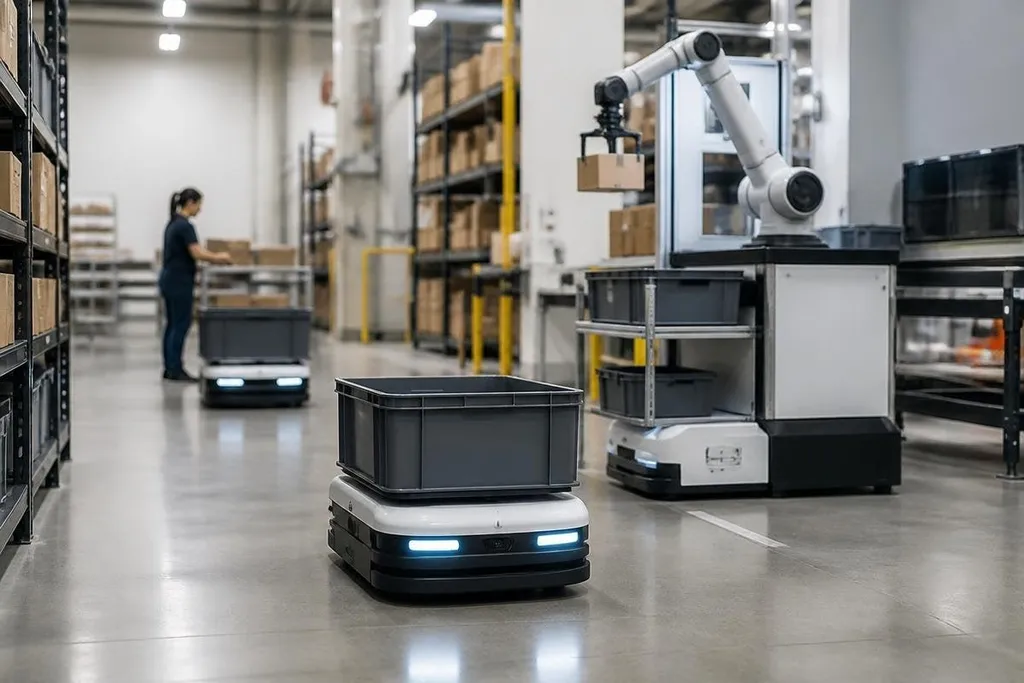
Mobile robots are moving past fixed routes and simple cargo runs. The areas worth watching now are better movement, safer work near people, stronger handling, and longer operation between charges.
If you’re deciding where robotics investment may matter, these are the technical changes to watch rather than broad product claims.
- Better movement: LiDAR, cameras, and mapping software help robots handle changing spaces.
- Useful hands: Grippers and force sensors let mobile robots pick up more than uniform boxes.
- Less downtime: Battery swapping and smarter charging can keep machines working longer.
Movement beyond fixed routes
Many mobile robots work best when their path stays clear and their map stays stable. The next step is software that can deal with pallets, people, open doors, and small changes in the floor plan without stopping for an operator.
LiDAR measures distance with light. Cameras add shape and color, while simultaneous localization and mapping, or SLAM, helps a robot build a map and locate itself inside it. The useful test is not whether the robot can follow a marked route. It’s whether the robot can recover when that route changes.
This matters in warehouses, hospitals, and factories where a blocked aisle can turn a routine delivery into a manual job. A robot that can stop, check its surroundings, and choose a safe path needs fewer fixed rules in its operating area.
Mobile robots that can handle objects
Transport is only one part of the job. A mobile robot becomes more useful when it can pick up a tote, open a cabinet, or place an item on a shelf without a custom fixture for every task.
That work depends on the arm, gripper, cameras, and force sensing working as one system. The gripper must find the object, apply enough pressure, and release it without damaging the item. A moving base also has to stay stable while the arm reaches away from the chassis.
The hard part is variation. Boxes have known shapes. Loose packages, soft goods, and partly hidden objects do not. A product claim about general handling should come with the object types, success rate, and operator input used in the test.
For mobile robots working near people, a useful report should show how the machine stopped after a person entered its path and how it resumed once the route was clear. Mobile robotics reporting from Robot24.com can tie that test to a named robot, site, and date. The next check is whether the safety system still works when traffic changes or the route is blocked.
Safer work beside people
Mobile robots will share more spaces with staff, patients, and visitors. That puts sensing and control ahead of top speed. A machine that moves at a lower speed but stops reliably near a person may fit a site better than a faster unit that needs a wide empty lane.
Safety depends on more than obstacle detection. The robot needs clear stop behavior, a reachable emergency stop, defined limits for speed and force, and a plan for faults in sensors or communications. Site design matters too. Blind corners, poor lighting, and crowded routes can expose weaknesses that a clean demo avoids.
The useful evidence is specific: the robot’s speed limit, stopping distance, sensor layout, and safety standard. Claims about safe operation mean little without those details.
Power, charging, and service
Battery life affects the work more than a headline range figure. A robot may run for several hours in a light task, then use more power while carrying loads, climbing ramps, or moving through a busy site.
Charging systems are becoming a larger part of the design. A robot can return to a dock, swap a battery, or charge during scheduled pauses. Each choice changes floor space, labor, maintenance, and the number of machines needed for a shift.
Service access matters just as much. Wheels, covers, batteries, sensors, and grippers will need replacement. A robot that takes hours to repair can lose more working time than one with a shorter published runtime but quick access to common parts.
A practical buying check
Use this list before treating a mobile robot claim as ready for your site:
- Name the task: record the load, route, handoff, and number of trips per shift.
- Test the bad route: add a blocked aisle, a person crossing, poor lighting, or a changed shelf position.
- Measure operator time: count the minutes spent clearing faults, confirming deliveries, and restarting jobs.
- Check the service plan: ask who replaces wheels, batteries, sensors, and grippers, and how long each repair takes.
- Price the whole system: include docks, network work, site changes, training, spare parts, and software fees.
I’d watch recovery from ordinary failures more closely than a smooth demonstration. A robot that resumes work after a blocked route or failed handoff has answered a harder question than one that completes a perfect run.
The next useful proof will be simple: how many tasks a mobile robot completes in a real site before a person has to step in.